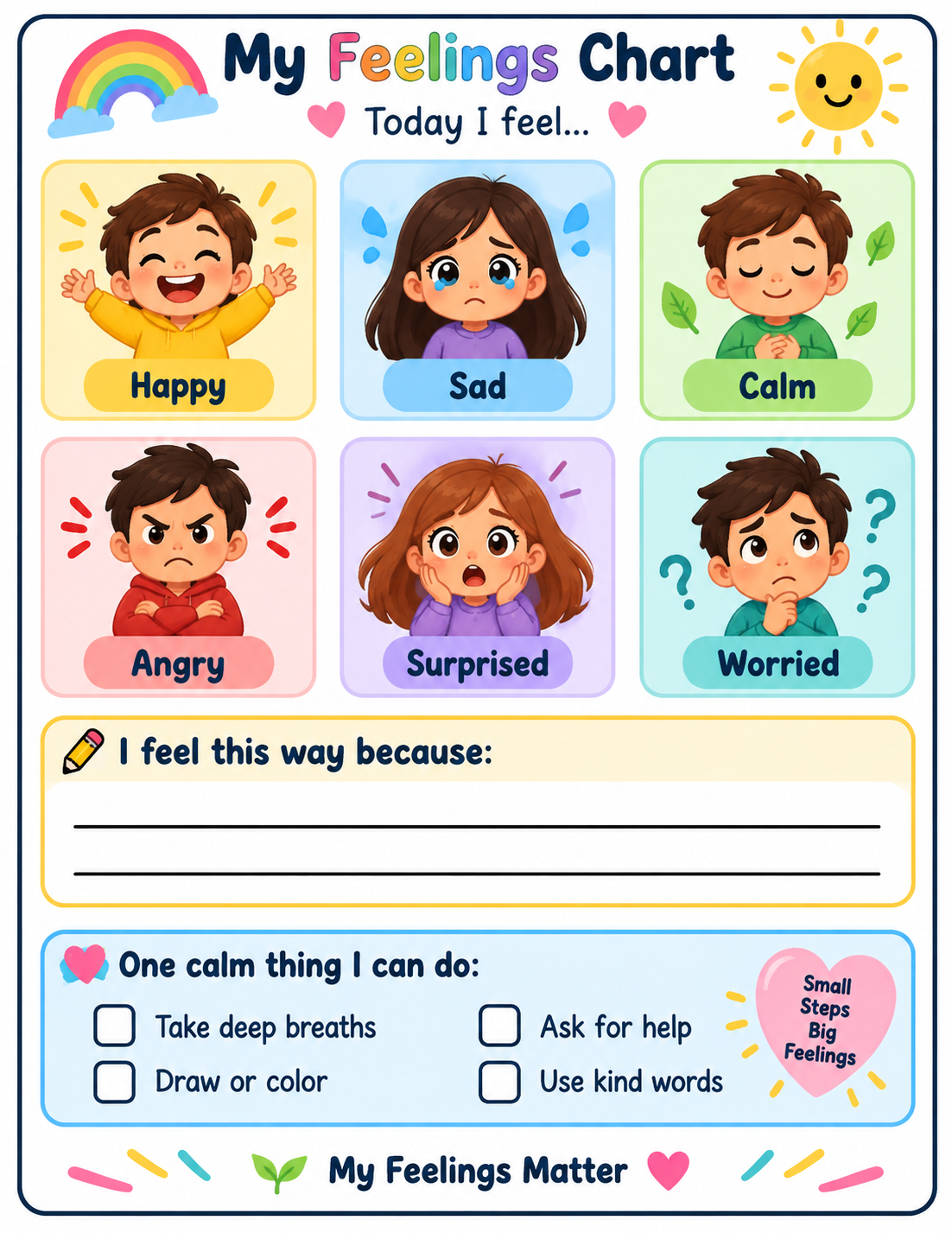
Feelings Chart for Kids

Feelings Chart for Kids
Help children recognize emotions, understand how they feel, practice simple calming skills, and enjoy an interactive feelings activity.
🌈 Meet Your Feelings
Feelings can change throughout the day, and every feeling tells us something. Tap a picture below to explore an emotion and discover a simple way to handle it.
✨ Pick another feeling whenever you like.
🧠 What Can Feelings Tell Us?
Feelings are clues about what is happening inside us. Learning to name a feeling can make it easier to talk about it and decide what to do next.
🌈 Helping Kids Understand Their Feelings
Learning to recognize emotions is an important part of growing up. A feelings chart for kids gives children a simple visual way to identify emotions such as happy, sad, angry, worried, calm, and surprised. Instead of struggling to explain what is happening inside, children can look at the faces, choose the feeling that matches, and begin talking about it.
Parents and teachers can use the chart during everyday moments. Try asking, “Which face shows how you feel right now?” Then give the child time to explain what happened. There is no wrong feeling. The goal is to help children notice their emotions, name them, and learn healthy ways to respond.
This feelings chart for kids can also be useful during quiet time, classroom check-ins, after a difficult moment, or before bedtime. Children can choose an emotion and then pick a calming action, such as taking deep breaths, drawing or coloring, asking for help, or using kind words.
With regular practice, children can build a stronger feelings vocabulary and become more comfortable talking about their emotions. Keep the activity relaxed and positive, and remind children that feelings can change throughout the day.
🌟 Feelings Challenge
Pick one feeling you had today and turn it into a tiny feelings mission.
Free Feelings Chart for Kids
Use this printable feelings chart after the interactive activity. Children can choose the face that matches how they feel, write or talk about why they feel that way, and pick one calm action to try.